Tuesday, June 26, 2007

Today is NATIONAL CHOCOLATE PUDDING DAY


Happy National Chocolate Pudding Day! YUM – Could there be a better holiday?!?! Chocolate pudding is such an American classic. You can make it in less than two minutes thanks to the instant pudding people, you can rip off a lid and enjoy it immediately now thanks to the pudding cup manufacturers (I always worry about shelf stable dairy products, but that is another topic). Or you can really treat yourself, take about a half-hour and make it from scratch.

So rich and creamy! Chocolate pudding is essentially the same as custard, the difference being the added cornstarch to make it thicker. Pudding, or a version of we call pudding today, dates back to the Middle Ages where they would make sweet pudding-like custards flavored with honey and nuts. In the late 1800’s and early 1900’s, pudding was fed to children and invalids not as a dessert but as high-caloire, wholesome food to those with little appetite.

In 1918 the first packaged pudding was introduced to the marketed by My*T*Fine. Jell-O did not introduce its chocolate pudding mix until 1934 as Walter Baker’s Dessert, changing it to Jell-O in 1936.

The key to making chocolate pudding is to use a heavy bottomed pot over medium-low heat to prevent the milk from scorching and to stir it constantly to prevent it from sticking. Some people push their pudding through a fine-mesh sieve after it has cooked to remove any lumps that formed while cooking. Pudding can be eaten warm, striaght from the stove top or cooled in the refrigerator. If you do not like a thin film or skin on the top of your pudding, then press a sheet of plastic wrap over the top while it cools.

Milk Chocolate Pudding
Gourmet, February 2007 from
epicurious.com
.
2 tablespoons sugar
2 tablespoons cornstarch
2 tablespoons unsweetened cocoa powder
1 1/2 cups whole milk
1/2 cup heavy cream
4 oz fine-quality milk chocolate, chopped
1 teaspoon pure vanilla extract

.
Whisk together sugar, cornstarch, cocoa powder, and a pinch of salt in a 2-quart heavy saucepan, then gradually whisk in milk and cream. Bring to a boil over moderately high heat, whisking constantly, then boil, whisking, 2 minutes. (Mixture will be thick.) Remove from heat.

.
Whisk in chocolate and vanilla until smooth.Transfer to a bowl and chill pudding, its surface covered with wax paper (to prevent a skin from forming), until cold, at least 2 hours.

Cooks' note: Pudding can be chilled, covered with plastic wrap after 2 hours, up to 3 days.

Tuesday, June 12, 2007

Shrimp in Spicy Tomato Sauce


Tonight for dinner I threw together a tasty dish and thought I would share it with you. It was very easy and while I know my on-hand stock is not like most, I made it from ingredients I had available to me. It can easily be modified with items you have on-hand.

It started with shrimp that I had picked up on sale. I think the hardest part of cooking with shrimp is peeling and deveining them. If you can find already peeled and deveined shrimp, it is worth the investment. They cost a bit more, but save you so much time. Also, I like to purchase the biggest shrimp I can find. It is less work if you are peeling and deveining and large shrimp feel so much more indulgent!

When buying shrimp, the size of the shrimp is indicated by the number on the bag. The number refers to the amount of shrimp in a pound. For instance 16/20 means that 16 to 20 of that size shrimp will make up a pound (large shrimp). The largest shrimp are U/10 or U/12 meaning under 10 or 12 in a pound. The smallest shrimp are 51/60 and 61/70.

Keys to buying shrimp:

  • Always purchase raw shrimp. Pre-cooked shrimp are already overcooked so if you will be heating them they are going to taste like rubber.
  • Unless you live where you can buy truly fresh shrimp, buy your shrimp frozen. Keep them frozen until you are ready to use them. Either defrost them in the refrigerator or I like to defrost them in a colander under cool running water. It takes about 1/2 hour or so.

To clean the shrimp, remove the shell. Then run a sharp paring knife down the back of the shrimp and remove the brown/black line (this is deveining). I like to do this under running water, it allows the vein to rinse away easily.


Shrimp in Spicy Tomato Sauce
Serves 4

1 tablespoon oil (canola or olive)
1 small onion, finely diced
3 stalks celery, finely diced
1 or 2 cloves garlic, minced
1/2 cup white wine (I used Pinot Grigio)
14 ounce diced tomatoes (I love Muir Glen’s Fire Roasted Tomatoes)
2 tablespoons tomato paste
1 teaspoon chili sauce (I used Sriracha), or to taste
1/4 teaspoon salt
1 pound shrimp, peeled and deveined (16/20 sized)
1/3 cup heavy whipping cream
2 tablespoons sour cream
1/4 teaspoon freshly ground black pepper
1 tablespoon chopped fresh basil
1 tablespoon chopped fresh chives

Serve over orzo (rice shaped pasta) or other pasta, white or brown rice, barley or steamed vegetables

Heat oil in large skillet over medium-low heat. Add onion and cook for about 5 minutes. Add the celery and cook them both until the onions are almost translucent. I like to slowly cook my onions to allow the taste to mellow. Many recipes say to cook over medium or high heat and that is acceptable but not how I prefer to cook. And by adding the celery second, it will give the final dish a bit of crunch. The celery can be added at the same time as the onion if you prefer no crunch.

Meanwhile, start preparing the pasta, rice or whatever you will be serving the shrimp over. I used orzo, a rice-shaped pasta. It is sold in the pasta aisle in the market and is great because it cooks in only 5 minutes.

Once the onions and celery have cooked, add the garlic and cook stirring constantly for about 30 seconds. This allows the garlic to cook without burning. Then add the wine and increase heat to high. Allow to boil for about 5 minutes until it has reduced by half.

Add the tomatoes, juice and all, chili sauce, tomato paste and salt. Cook and continue to boil until most of the juice has evaporated, about 3 or 4 more minutes. Once it has reduced to the consistency you like, add the shrimp and cook them for about 1 to 2 minutes. Stir constantly and as soon as they have lost their opaque color and turned pink they have finished cooking.

Stir in heavy cream, sour cream, black pepper and sprinkle with fresh herbs. Stir until warm only about 1 minute more.

Serve over pasta or rice with some roasted asparagus, a nice mixed green salad or steamed green beans.

Modifications: You do not have to add both the celery and onions, you could leave out one or both or substitute shallots if you have that instead. Instead of using white wine, you could omit or substitute chicken or vegetable stock. Adding regular diced tomatoes will do if you do not have fire roasted. Stewed or crushed tomatoes would work well also. The tomato paste just thickens the sauce quickly. You could omit and cook a bit longer. You could use regular milk instead of cream, sour cream only or leave them out for a tomato sauce that isn't creamy. Other herbs to use instead of basil and chives - thyme, parsley, oregano.

Monday, June 11, 2007

A Moment of Silence


What do Cheez Whiz and McDonald's French Fries have in common?

Edwin Traisman. The food scientist who helped invent Cheez Whiz in the 1950’s when he worked for Kraft foods and later as a franchaise owner invented a process for McDonald's to help keep their french fries consistent passed away last week at 91.

Mr. Traisman was highly regarded in the food industry. He was a pioneer and will be missed. Read more about Mr. Traisman

Tuesday, May 29, 2007

Super Spinach

I'm Popeye the Sailor Man
I'm strong to the "Finich"
'Cause I eats me spinach
I'm Popeye the Sailor Man

(I hope you sang this out of the side of your mouth)

Spinach is one of those foods as a child I always detested. I do not know if I tried it (although knowing my mom I did try it), or if it was one of those foods you just don't like - lima beans, brussels sprouts, spinach. But somewhere through the years, I have learned to love it. It is a great vegetable either raw or cooked. Spinach salads are very much common place in restaurants today. It is great to eat on pizza, in pasta, or wilted with garlic and olive oil.

Spinach is a super food. Super foods are readily available whole foods that are nutritionally dense. Spinach is packed with at least 13 different types of flavonoid compounds, which act as antioxidants and in studies have reduced cancer cell growth in several types of cancer (stomach, breast, skin and prostate). Spinach has more than 100% of the daily recommended allowance for Vitamin K (bone health) and vitamin A (helps vision and helps the body absorb calcium). Spinach is great source for folate, magnesium, vitamin E and iron. And probably some of the best news, spinach has been shown in studies to reduce the effects of age-related decline in brain function. A study in the journal Neurology found that eating just three servings of green leafy, yellow and cruciferous vegetables each day can slow the decline in age-related brain function by 40%.

Thought to have originated in ancient Persia (Iran today) and was called aspanakh, Spinach only made its way to Europe in the 11th century. It grew well in Europe, since it is not grown well in hot, arid climates and flourished in Spain and Italy and has been incorporated into what we now know as the Mediterranean diet.

There are three types of spinach: flat (or smooth) leaf, savory and semi-savory. The flat leaf has an unwrinkled, spade shaped leaf. This is most commonly found in processed spinach (canned, soups, baby food, etc), frozen spinach and as baby spinach. Savory spinach has a wrinkled leaf and is often found tied in bunches in the produce section. Semi-savory spinach has slightly curly leaves and has gained popularity recently. All three varieties taste the same.

Fun spinach facts:
* Spinach was the first frozen vegetable to be sold.
* Three towns in the U.S. claim to be the spinach capital of the world and hold Spinach Festivals. They are Lenexa, Kansas (Saturday, September 7, 2007); Crystal City, Texas (November 10, 2007); and Alma, Arkansas (April 19, 2008).
* Scientists are using the way spinach converts sunlight into energy to possibly power laptops and cell phones. Read more

Spinach grows best in sandy soil, so it should always be well washed before using it. Flavors that compliment spinach include bacon, butter, lemon, nutmeg, olive oil, Parmesan cheese and red wine vinegar.


527 Recipes at Epicurious.com
82 Recipes at LoveToKnow.com
10 Recipes at SpinachRecipes.org

Bon appétit!

Monday, May 21, 2007

Plentiful Peas

As promised … peas!

Peas do not fair well in the hot summer sun – the best time is spring! There are more than a thousand varieties of peas. We mainly enjoy three types: the Snow Pea in which the pea itself does not get very big, so you can enjoy the pod and all; the Snap or Sugar Pea which also can be enjoyed whole, but you need to zip the strings off; and the English or Garden Pea which has a tough pod so you shuck the peas out.

The English word for pea was originally pease. People thought that this was the plural form and began dropping the –se, forming the word we use today. Peas are one of the earliest food crops cultivated. Archeologists have found evidence near the border of Burma and Thailand that dates back to 9750 BC .

In Chinese history, an emperor in 5000 BC is said to have discovered peas. He wandered across the land looking for plants for food or medicine. Possible plants were given to first a dog, then a servant to see if they would survive. If both survived, the plant was deemed edible. Lucky dog and servant (that time)!

Peas are part of the legume family, making them high in protein and fiber and low in fat. They also are a good source of antioxidants and calcium, and can help lower your cholesterol. However, peas are a starchy vegetable with a high glycemic index meaning that your body absorbs them quickly, raising your blood sugar levels. So remember, everything in moderation.

Peas are grown in North America, Europe, India, Australia and Russia. If you are thinking of growing your own, it is said it is good luck to plant your peas on St. Patrick’s Day. Peas grow in two forms, dwarf (or small plants) and vines. Vines make a great climber to add a trellis in front of a fence or on a patio.

In the 1920’s, frozen vegetables were introduced into the market. This was a huge advantage for pea farmers. They could harvest the peas and freeze them almost immediately. This prevents the sugars in the peas from turning into starch, giving us the flavor of freshly-picked peas.

Frozen peas are a staple in my freezer. I love adding them at the last minute to rice, pasta, soup and stew dishes. I add them at the very end still frozen, allowing them just enough time to defrost but without losing their crispness (about 3-5 minutes). I love the feel of the peas popping in my mouth.

Another great way to enjoy peas is sauté with butter and chopped fresh mint. You could add some finely diced shallots, mushrooms or ham or bacon to the peas as well.


RECIPES:

Creamed Peas

Elixir of Fresh Peas (soup) "This pale green froth of a soup is the essence of fresh peas."

Sweet Pea Soup with Lemon-Pepper Cream

Link to list of several dozen Garden Pea Recipes

Tuesday, May 08, 2007

Produce Availablility

When I opened up the blog this morning, I really had no idea what I was going to write about. I thought about continuing on with my spring produce list, but wasn't sure which item to showcase. So I was doing some searching and ran across a Produce Availability Chart for a farm in Pennsylvania. It is a very interesting chart and think that Michigan's produce has to be similar. I think my next blog will be about peas.
.
Since the farmer's markets are opening now, I will be showcasing the local farmers markets in upcoming blogs - my plan is to visit them and let you know what each offers. I know of at least a half dozen in the area. I am very excited about being able to purchase locally grown produce. You can find a farmers market in your area. Sunday I had the opportunity to visit the Old Town Farmers Market. It is a newly started market and there were very few vendors - none yet with produce. I did meet some extremely knowledgeable and kind people from Hannewald Lamb Company. They raise grass and grain feed, hormone free lamb in Stockbridge. I have never cooked lamb, so I bought a couple of steaks. I received some great tips. I will let you know how that turns out.
.
And on another completely unrelated rambling note, I attended a composting seminar last night. This is something I have wanted to do for several years now, but have not taken the time to educate myself on how to get started. An extremely patient and educated man from the City of Lansing basically gave me a private lesson on how to start composting. I learned that the City of East Lansing sells a composting bin for $35 at the Public Works Department. map Moisture is the key to composting (keep it as damp as a wrung out sponge). And by attending a $15 four-week class and doing 20 hours of community service, I can become a Master Composter. Things are too crazy right now, but next spring it may be in my future. :-)
.
Today's blog ended up being unrelated, oddities. Sorry! But I promise to follow up on these topics and bring you more information.

Wednesday, April 18, 2007

Why Go Organic?

I subscribe to the George Mateljan Foundation's World's Healthiest Foods newsletter. It is very informative and I would recommend checking it out. I thought I would share a recent letter with you, I found it very interesting.

March 26, 2007

Dear Friend,

Need more reasons to eat organic? Studies have found that organic farming is highly preferable to conventional agriculture in terms of its effects on the environment. A yearlong experiment, conducted in an established apple orchard on a 4-acre site in the Yakima Valley of central Washington, used some trees raised with conventional synthetic fertilizers; others grown organically without pesticides, herbicides or artificial fertilization; and a third group raised on integrated farming, which combines organic and conventional agricultural techniques.

One goal of the study was to compare the amount of nitrogen leaching into the soil. When present in excess of the amounts needed by plants, nitrates percolate through the soil, contaminating surface and groundwater supplies. The researchers measured nitrate leaching during the entire year and found it was 4.4 to 5.6 times higher in the conventional treatment than in the organic treatments, with the integrated treatment in between.

The research team also compared the amount of nitrogen gas released into the atmosphere. Nitrogen compounds from fertilizer can enter the atmosphere and contribute to global warming. Air samples collected in the orchard after the fall and spring fertilizations revealed that organic and integrated soils emitted larger quantities of an environmentally benign gas called dinitrogen (N2) than soils treated with conventional synthetic fertilizer.

Modern conventional farming practices have also led to nutrient-poor food. The mineral content of vegetables has dropped significantly over the last few decades. Today, you need to eat almost twice as many carrots and three times as much broccoli to get the same amount of calcium you would have received from one serving of these vegetables in 1950. The lesson is clear: organically grown foods are the better choice to promote the health of both ourselves and our planet.

George Mateljan

Kramer SB, Reganold JP, Glover JD, Bohannan BJ, Mooney HA. Reduced nitrate leaching and enhanced denitrifier activity and efficiency in organically fertilized soils. Proc Natl Acad Sci U S A. 2006 Mar 13; [Epub ahead of print] PMID: 16537377

Davis DR, Epp MD, Riordan HD. Changes in USDA food composition data for 43 garden crops, 1950 to 1999. J Am Coll Nutr. 2004 Dec;23(6):669-82. PMID: 15637215

Monday, April 16, 2007

Goodbye Elsie


April 16, 1941 The original Elsie the Cow died. Elsie the cow was originally a cartoon character appearing in ads for Borden Milk. At the 1939 New York World's Fair, when people began asking where Elsie was, Borden's picked a cow originally named 'You'll do Lobelia' from their herd to be Elsie. Elsie stared in commercials, made personal many appearances, and even starred in an RKO movie, 'Little Men.' Elsie was injured in a truck accident in 1941 and had to be put to sleep. She is buried in Plainsboro, New Jersey. .......

http://foodreference.com/


Isn’t she sweet? She rode first class, she had her own boudoir and four-poster bed. Should we take a moment to pay our respects? (Those of you who know me, know my love of cows.)

Cows make milk (about 400 glasses of milk per day actually), which is used to make cheese! Cow’s milk, sheep’s milk, goat’s milk and buffalo’s milk – there are hundreds of types of cheeses – hard, soft, smoked, flavored, cubed, shredded, melted, French, Swiss, Welch, farmer’s, artesian. Cheese, glorious cheese.

Cheese is organized into four main types:
.....soft (cottage, cream, mozzarella, brie);
.....semi-soft (Colby, Monterey jack, Queso Fresca);
.....semi-hard (cheddar, provolone, gouda); and
.....hard (parmesan, asiago, gruyere).
The moisture content of the cheese affects its texture and defines which category the cheese belongs to.

Great detailed list of each of these types of cheese

Soft Cheeses
Semi-Soft Cheeses
Semi-Hard Cheeses
Hard Cheeses


Making cheese at home can be really quick, easy and very tasty. This recipe is from Home Cheese Making: Recipes for 75 Delicious Cheeses by Ricki Carroll.

30 Minute Mozzarella [more like 1 hour]
Yields 3/4 to 1 pound

1 1/2 level teaspoons citric acid dissolved in 1/4 cup cool water
1 gallon pasteurized whole milk
1/8 to 1/4 teaspoon lipase powder, dissolved in 1/4 cup cool water and allowed to sit for 20 minutes (optional)
1/4 teaspoon liquid rennet (or 1/4 rennet tablet) diluted in 1/4 cup cool water (unchlorinated)
1 teaspoon salt

While stirring add the citric acid solution to the milk at 55° F and mix thoroughly. (If adding lipase, add it now.)

Heat the milk to 88° F over medium/low heat. (The milk will start to curdle.)

Gently stir in the diluted rennet with an up-and-down motion, while heating the milk to between 100 and 105° F. Turn off the heat. The curds should be pulling away from the sides of the pot; they are ready to scoop out.

The curds will look like thick yogurt and have a bit of shine to them, and they whey will be clear. If they whey is still milky white, wait a few more minutes.

Scoop out the curds with a slotted spoon and put into a 2-quart microwavable bowl. Press the curds gently with your hands, pouring off as much whey as possible. Reserve the whey.

Microwave the curds on HIGH for 1 minute. Drain off all excess whey. Gently fold the cheese over and over (as in kneading bread) with your hand or a spoon. This distributes the heat evenly throughout the cheese, which will not stretch until it is too hot to touch (145° F inside the curd).

Microwave two more times for 35 seconds each; add salt to taste after the second time. After each heating, knead again to distribute the heat.

Knead quickly until it is smooth and elastic. When the cheese stretches like taffy, it is done. If the curds break instead of stretch, they are too cool and need to be reheated.

When the cheese is smooth and shiny, roll it into small balls and eat while warm. Or place them in a bowl of ice water to 1/2 hour to bring the inside temperature down rapidly; this will produce a consistent smooth texture throughout the cheese. Although best eaten fresh; if you wait, cover with the reserved whey and store in refrigerator.

Chef Jen’s notes: I was able to find rennet tables in the ice cream topping aisle of the market and both rennet and citric acid can be found in the health food stores (bulk spice aisle). I was unable to find lipase. I know all of these itmes are readily available online. Make sure you have a clean pair of dish washing gloves available, the cheese gets extremely hot and is too hard to handle without them.


For my cream cheese loving fans, here are a few links to making your own cream cheese.

Making Cream Cheese At Home
How To Make Cream Cheese

I have not made cream cheese (but am now inspired to do so) so I cannot authenticate either of these recipes. I think I will soon be making some cream cheese and will post on it when I do.

My next post will be back to spring ingredients, I just could not resist my first love (cheese).

Monday, April 09, 2007

Ripe Rhubarb

Rhubarb is a sour, astringent tasting vegetable, which is normally eaten as a fruit. Its tart nature is usually married with a large amount of sugar in pies, cobblers, jams and other desserts. This perennial plant grows well in regions with a cold winter, as it needs the cold for its winter dormancy – growing well in areas such as Siberia and Alaska.
.
The name rhubarb derives from the Latin rha barbarum. Rhubarb was found growing along the banks of the Rha river, the previous name for the Volga river. (The geography buff in me has to give a bit of information – the Volga is the longest river in Europe, starting in the northwestern part of Russia and draining in the Caspian Sea – see map) The Romans considered Russia to be barbarian territory. So the name rha barbarum, literally means from the barbarian, Rha.

The red and green, celery-like stalks are the only edible parts of the rhubarb plant. Rhubarb is high in Vitamins A & C and dietary fiber. The leaves and roots of the plant are toxic due to the excessive amount of oxalic acid. Oxalic acid is corrosive to your body tissue, removing calcium from the blood.

When buying rhubarb, look for stalks with a bright, vivid color and ones that feel dry, firm, and crisp. Avoid stalks that are limp or wilted or have brown areas. About an hour before cooking with rhubarb, stand the stalks in cold water to refresh and crisp them.

Looking for a road trip? Kankakee, Illinois, about 45 miles south of Chicago is hosting their annual Rhubarb Festival on Sunday, May 20. With live music, rhubarb pie eating and tours of their one-room school house it sounds like an interesting stop.

RHUBARB PICO DE GALLO
Make about 4 cups

1 cup diced rhubarb
1 cup diced tomatoes
1/2 teaspoon salt
1 cup diced white onions
1 1/4 cup chopped fresh cilantro
juice of 1/2 lime


Combine all ingredients in a bowl and mix together. Refrigerate. Serve cold with tortilla chips.


PORK TENDERLOIN WITH SPICED RHUBARB CHUTNEY
Serves 4

CHUTNEY:

3/4 cup sugar
1/3 cup cider vinegar
1 tablespoon minced peeled fresh ginger
1 tablespoon ground garlic
1 teaspoon cumin
1/2 teaspoon ground cinnamon
1/2 teaspoon ground cloves
1/4 teaspoon dried crushed red pepper
4 cups 1/2" cubed fresh rhubarb, about 1 1/2 lbs
1/2 cup chopped red onion
1/3 cup dried tart cherries or golden raisins

PORK:
2 pork tenderloins (about 1 1/2 pounds -- trimmed)
2 teaspoons ground cumin
1 tablespoon olive oil
Fresh cilantro sprigs, for garnish

For the chutney:
Combine first 8 ingredients in heavy large Dutch oven. Bring to simmer over low heat, stirring until sugar dissolves. Add rhubarb, onion and dried cherries; increase heat to medium-high and cook until rhubarb is tender and mixture thickens slightly, about 5 minutes. Cool completely. (Can be made 1 day ahead. Cover and chill. Bring to room temperature before using.)

For the pork:
Preheat oven to 400°F. Sprinkle pork with cumin. Season with salt and pepper. Heat oil in heavy large skillet over high heat. Add pork and brown on all sides, about 5 minutes. Transfer to roasting pan. Brush pork with 6 tablespoons chutney. Roast until thermometer inserted into center of pork registers 155°F, brushing occasionally with 6 more tablespoons chutney, about 25 minutes. Slice pork into medallions.
.
Garnish with cilantro and serve with remaining chutney.
.
.

Tuesday, April 03, 2007

Succulent Strawberries


Strawberries are another springtime favorite. These delicious red berries are the world’s most widely distributed fruit. A member of the rose family, it is the only fruit to have its seeds on the outside and is indigenous to almost every continent, exceptions being Africa and Australia.

There are two types of strawberries, an old-word variety (duchesnea) native to Europe and the new-world variety (fragaria) we consume today which are a hybrid of North American and South American berries. The species name fragaria comes from the root word fragans, a Latin term meaning sweet smelling.

And there is nothing like the sweet smell of strawberries. I love the berries right off the plant, warm from the spring sun. Strawberries are a common dessert fair – strawberry shortcake, strawberry cheesecake, strawberry jam. And we think of strawberries classically paired with cream or champagne. Strawberries are great when paired with:
.
Almonds.................Crème fraiche..................Port
Basil.......................Currant, black.................Rhubarb
Brown sugar............Figs...............................Sherry
Champagne.............Grand Marnier.................Sour cream
Cinnamon...............Lemons..........................Sugar
Cognac...................Maple syrup....................Vinegar, balsamic
Cointreau................Mascarpone...................Wine, esp. red
Cream....................Nuts..............................Yogurt
Cream cheese..........Pepper, black or pink
Taken from Culinary artistry (by Andrew Dornenburg and Karen Page ©1996)
.
Strawberry Cream Cheese
.
1 cup strawberries, hulled
8 ounces cream cheese, at room temperature
powdered sugar, to taste
.
Mash the strawberries into the cream cheese until smooth. Add powdered sugar a tablespoon at a time until you have received your desired sweetness level (will depend on sweetness of berries).
.
Spread on toasted bagels or bread, or apple slices . Or serve with pretzel rods.
.
.
Strawberry Spring Salad Variations: Try substituting spinach for the greens. Add thinly sliced red onions. Substitue pecans or almonds for the pine nuts. Add a cheese, like brie or feta.
.
Strawberries in Red Wine Serve with alone or warmed slightly over vanilla ice cream.
.
Strawberry Cream Dream Muffins For my cream cheese loving fans - a strawberry and cream cheese muffin with a center of white chocolate
.
Strawberry Recipes Michigan Dept of Ag recipes (scroll down to find list for strawberries)
.
.
Find the closed market to your home and in a few weeks, go find some delicious red berries:
Michigan's Farmers Market and U-Pick Directory A guide to finding your own locally grown berries

Monday, March 26, 2007

Asparagus


As the weather warms and spring approaches, I am going to be adding posts about springtime harvests. The first one that comes to mind and one of my favorites is asparagus.

The word asparagus derives from the Greek word aspharagos meaning 'sprout'. If you have ever seen asparagus growing, you can see it is aptly named. Asparagus, which is a member of the Lily family, grows well in Michigan.

Asparagus is a very nutritionally balanced vegetable. It is a good source of potassium, fiber, folic acid, thiamin and vitamins A, B6, and C.
.
People have enjoyed asparagus for thousands of years. The Romans and Greeks enjoyed it for its flavor and for its medicinal purposes. It was used to heal toothaches and bee stings. During the Renaissance, asparagus was banned from nunneries because it was considered an aphrodisiac. Today it is used to treat urinary tract infections and kidney stones.
.
Because asparagus has such a fantastic, vibrant flavor, it tastes great when prepared very simply. Two of my favorite methods are blanching or roasting.
To blanch: remove woody ends and place in pot of boiling, salted water for 3 to 4 minutes until spears turn bright green. Remove and place immediately in a bowl of iced water to stop cooking process.
.
To roast: remove woody ends and lightly oil spears with olive oil. Season with coarse salt and freshly ground black pepper. Place on baking sheet in a preheated 400°F oven for 8 to 12 minutes depending on how thick the spears are.
It is great in wraps and sandwiches; egg dishes like omelets, frittatas and quiches; in chicken and fish dishes and in salads.
.
Michigan Asparagus Advisory Board offers tips for storage, cooking and recipes.
.
.
Nearly 250 recipes on Epicurious.com
.
Next time you are at the market, look and see if the small, thin, early spears of asparagus have arrived, buy a bunch and enjoy!

Monday, March 19, 2007

Sorry for my absence

I apologize for those few Presto! blog readers out there for my absence. The beginning of the year has been busy, busy, busy! Besides my usual client and event load, I have been teaching classes through several community enrichment programs.

Classes held include:

Caribbean Cuisine

Eastern European Cuisine

Indian Cuisine

Mexican Cuisine

Foods for Women - what we should be eating

Healthy Eating - easy ways to eat healthier

One Pot Meals - although this class was cancelled

I have upcoming classes if you are interested. Brunch Basics is a hands-on class being held Saturday, April 14 (10 am to 12 pm) and Grilling 101 is a demonstration class being held Tuesday, May 15 (7 pm - 8:30 pm). Visit Delta Township for additional information on either.

So thank you for your patience. You will be rewarded with some great spring food facts and recipes. Stay tuned!

Wednesday, January 17, 2007

Ahhh Soup!


Winter is here and with the drastic dip in temperatures it has me craving a hot bowl of soup. There are soups for everyone and every occasion ~ cream-based soups and broth-based soups, meat soups and vegetarian soups, hot soups and cold soups.


The soup I have been eating the longest in my life, probably is borscht. I know, not your typical soup, but a family tradition in my Polish/Czech family. It is our Easter Sunday meal, without fail. Although we usually have a simple, cream based version (essentially cream and beets).


Each person receives a bowl and they can doctor it up to their own specifications. Since it is Easter, we always have ham, polish sausage, hard-boiled eggs and horseradish (have to have the horseradish) that each person can add to our own bowls of delicious beet soup.

BORSCHT
Makes about 8 cups

7 medium sized red beets
4 1/2 cups vegetable stock or water
28 ounce whole plum tomatoes, drained and chopped
2 cups cabbage, shredded
1 large carrot, peeled and julienned
2 celery stalks, julienned
1 large leek, julienned
2 tablespoons tomato paste
1 tablespoon red wine vinegar
1 teaspoon fresh lemon juice
½ teaspoon salt
¾ teaspoon black pepper
1 tablespoon minced fresh dill

1 cup heavy cream (optional)
Sour cream, optional
Horseradish, optional

Preheat oven to 400° F.

Scrub beets, place together on a large piece of foil, wrap tightly and roast on a baking sheet for about 1 hour, until they can be easily pierced with a fork. Let cool, then slice and cut into thin strips.

Add stock to soup pot. Bring to boil, add tomatoes, cabbage, carrots, celery, leek and tomato paste. Simmer, partially covered until the vegetables are tender, about 30 minutes.

Add beets, red wine vinegar, lemon juice, salt, pepper, dill and cream if using. Simmer, partially covered for another 15 minutes.

Garnish with sour cream and horseradish, if desired.


Additional resources:


Wednesday, January 03, 2007

Happy New Year


Is one of your New Years resolutions to lose weight and eat healthier? This time of the year is a great time to assess where we are in our lives and make changes. Unfortunately most people fail to keep their resolutions. I read a statistic that said 80% of people have given up on their resolutions by January 20. Give up after 20 days, wow that is amazing.

My advice is to set reasonable goals. If your goal is to eat healthier, try another approach than starting a crazy diet that will only last one or two weeks. Make small changes in what you are already doing. If you are lacking in your fruit and vegetable consumption, make your goal to add one serving each day. Or make it a goal to include whole grains in two meals each week. Try switching from processed foods, like peanut butter to natural ones. Make small changes and stick with them.

One useful tip after you have set your goal is to determine what obstacles will stand in the way of meeting your goal. By realizing what problems you may encounter from the beginning, it can help you stay on track and meet your goals.


Remember it takes three weeks to make changes stick, so do not give up!

Monday, December 18, 2006

Holiday Hors D'oeuvres


While looking for some ideas for bring hors d'oeuvre to my own holiday party, I ran across some websites to share:

HGTV Easy Hor D'eouvre

Easy Dip Ideas

Appetizer/Hors D'oeuvre Index

Kraft Foods Ideas - search on left for 'Appetizers/Snacks'

Other easy ideas that people love:

Deviled Eggs - Always the first thing to go at any event. Whether they are traditional or have a non-traditional spin, like add fresh herbs or curry powder.

Toasted Mixed Nuts, I like to bake a variety of nuts in a 350°F oven for 10 to 15 minutes until just starting to brown. While they are roasting, I melt 1 stick of butter with about a 1/4 cup of brown sugar, a splash of hot sauce (or cayenne) and some chopped fresh herbs, like rosemary or thyme.

Boursin cheese goes great with some many things. I like the garlic and herb best. You can thin it with a bit of milk or cream and then pipe it onto crudité like cucumber rounds, cherry tomato cups and carrot and celery sticks.

Bon Appétit!

Tuesday, November 28, 2006

143 Years Ago Today


Today in 1863, Thanksgiving was first celebrated as a regular American Holiday. Abraham Lincoln ordered government offices closed for a day of thanksgiving and praise, the last Thursday of November. Thanksgiving has actually had an interesting past with our past Presidents. This New York Sun article explains its history well, beginning with George Washington.
.
The way we celebrate Thanksgiving today, and the version we see in so many plays is not exactly as it happened. Here are some interesting Mayflower Myths including the clothes they probably wore and the food they probably ate.
.
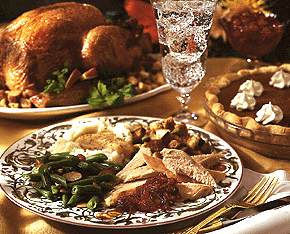
When we think of our Thanksgiving Day feast, we think of roasted turkey, stuffing, cranberries and mashed potatoes with gravy. As you can probably guess, this is probably not the meal of those early settlers on their day of thanksgiving. However, turkey is the only poultry native to North America. Cranberries are also native to North America. So it is not a stretch that the Pilgrims could have eaten these delicious morsels.
.
A bit late I know, but I hope you enjoyed your Thanksgiving holiday. I hope you were able to enjoy a fabulous feast with your loved ones and relax and enjoy life.

Monday, November 13, 2006

You Say Yam, I Say Sweet Pot-Ta-To

Yam, Sweet Potato. Sweet Potato, Yam. These are two terms for the same thing, right? As you can see by the photo, they are not the same. In the United States, we often use the name interchangeably.

The two are not related. The sweet potato is a root vegetable, part of the morning glory family and originates from Central and South America. The yam is a tuber originating from West Africa and Asia. When slaves arrived in the New World, they saw the sweet potato and called it yam since it looked similar to the vegetable from home.

The sweet potato has smooth, thin skin while the yam has rough, scaly skin. The sweet potato has a sweeter taste and feels moist in the mouth while in contrast the yam has a starchy taste and feels dry in the mouth. Sweet potatoes are high in beta-carotene while yams are not.

Yams, however are not commonly found in markets in the United States, so regardless of what the sign in the produce departments reads, you are most likely purchasing sweet potatoes. Yams are available in some Latin markets. I have not yet check our local international markets to see where they can locally be purchased.

Sweet potatoes are complimented nicely with brown sugar, butter, cardamom, cinnamon, cloves, coriander, cumin, ginger, lemon juice, lemon peel, mace, marjoram, nutmeg, orange juice, orange peel, poppy seed, sage, savory and thyme. They can be roasted, steamed, boiled, baked, sautéed, mashed and fried.

Recipe Links
North Carolina Sweet Potato Commission recipes. Can also request a free recipe brochure.

Tuesday, November 07, 2006

Glossary of Squashes & Gourds

I ran across this on Martha Stewart Living and thought you might find it useful this time of year, Glossary of Squashes and Gourds.
It lists 16 different winter squashes, showing photos and giving their names with some hints about each. I will also add it to my LINKS.

Friday, October 27, 2006

Cooking with Pumpkins

Pumpkins were once recommended for removing freckles and curing snake bites.
Pumpkins are not just for carving. Pumpkins, which are a member of the gourd family (related to squash, melons and cucumbers), are actually a fruit. They are native to Central America and can be grown on every continent except Antarctica. The word pumpkin is derived from the Greek word for large melon, pepõn.

Native American Indians had many uses for pumpkins, from eating to using dried strips to weave into floor mats. The Pilgrims were introduced to pumpkins when they arrived to North America and they became a staple in their diet as well. Today, we have moved away from eating pumpkin, except in the Thanksgiving standard – pumpkin pie.

Pumpkins are very nutritious, being rich in Vitamins A & C, beta-carotene, calcium, potassium and fiber. Pumpkins are 90 percent water. They are also low in sodium and fat, making them a great choice for those watching their weight.
Their orange flesh is mild and sweet. Pumpkin can be substituted for squash, such as butternut or acorn squash, in recipes. When purchasing a pumpkin, choose smaller ones, not the large ones used for Jack-o-lanterns or really small ones for decorating. Most frequently sugar pumpkins are what we find in markets for cooking, which are darker in color and rounder than the carving versions.

When purchasing a pumpkin, choose one that is heavy for its size and free of nicks, bruises or cuts. Make sure the flesh is firm, with no soft spots and the color is uniform. If you pick find a pumpkin that is still green (meaning it was picked too early), you can put it in a dark room for several days to finish the ripening process. Another important point is to make sure the stem is still intact. Because of the high sugar content, organisms will begin to decompose the pumpkin at the stem if the stem has been removed.

The most common way to cook a pumpkin is to simply roast it. Divide the pumpkin in half, removing the seeds and stringy pulp. Place the halves, cut side down on a baking sheet and bake for about one hour in a preheated 350° F oven, or until tender when pierced with a fork. Spoon the flesh out of the shell and use it in recipes. Cooking pumpkin at very high temperatures can cause the flesh to become stringy.

Pumpkin puree can be purchased in the market, usually with the other canned vegetables. It is convenient and you will give you a consistent taste and texture. Make sure to read the label and make sure you are getting 100% pumpkin. There are two types of canned pumpkin – unseasoned cooked pumpkin and pumpkin pie filling that has been seasoned with sugar and spices.

Link to recipes
Over 50 recipes at about.com
Half dozen or so main course recipes at Pumpkin Nook with dessert, snack and international recipes as well

Saturday, October 14, 2006

October 14


Today is National Chocolate Covered Insect Day
Ants, scorpions, crickets, grasshoppers, worms - all are available for your distinguished palate! McKandy.com boasts the largest selection of edible insects if you are interested. I have never in my life considering eating an insect. But since it is national chocolate covered insect day I, well, honestly am still not considering it. I expect them to be crunchy and do not think I can get past that part. But I guess I shouldn't knock it 'til I try it....

More importantly, October 14, 1834, Henry Blair received a patent for the seed planter. He is often cited as the first African-American to be granted a patent. Not much is known about Mr. Blair, but it has been presumed that he had been freed from slavery since slaves were not permitted to apply for patents. He signed his name on the patent with an "X" because he could not write.

So who was the first African-American to be granted a patent? In 1821, Thomas L Jennings received a patent for the invention of the dry cleaning process. Can you imagine life today without either? Bravo gentlemen!